How SwitchInsights approached this review: Fuse is a new supplier on top of an old wreckage of failures, so we looked harder at the things that actually make a supplier survive - pricing vs the cap, the hedging strategy, the app and customer service experience, the financial position, and what existing customers say on Trustpilot. Current as of May 2026. We'll update if new Trustpilot data lands, Fuse changes a tariff, or its funding position shifts.
Fuse Energy UK launched in July 2023 as the first new UK energy supplier since the 2021-22 crisis (29 suppliers gone, 4.2 million customers displaced).
Co-founders Alan Chang (ex-Revolut CRO) and Charles Orr are fintech operators, not energy lifers. Fuse Energy funding stands at $158m+ from Balderton, Lowercarbon, Accel, Lakestar, Ribbit, and Storonsky's QuantumLight - taking the Fuse Energy valuation to $5bn by year three.
By early 2026, Fuse serves 200,000+ UK households at $400m ARR (up 8x), cash flow positive. This Fuse Energy review asks: is the business model truly different from 2021's failures, and is the deal actually better?
📚 Quick context: the 2021 supplier collapses
The supplier failures happened in autumn 2021, before Russia invaded Ukraine. Wholesale gas prices climbed roughly 250% through 2021 on the back of low European storage and a tight global gas market, and that exposed which UK suppliers were just thin middlemen with no hedging book and minimal capital. 29 suppliers collapsed (including Bulb, with 1.6m customers, in November 2021). The Ukraine invasion in February 2022 then pushed bills to record highs - the consumer-bill crisis people remember from 2022-23 - but most of the supplier failures had already happened.
In the two years after the crisis, very few competitive fixed deals were available, prices stayed high, and no new suppliers entered the UK market. Fuse Energy was the first.
Enter Fuse: The Fintech Playbook Applied to Energy
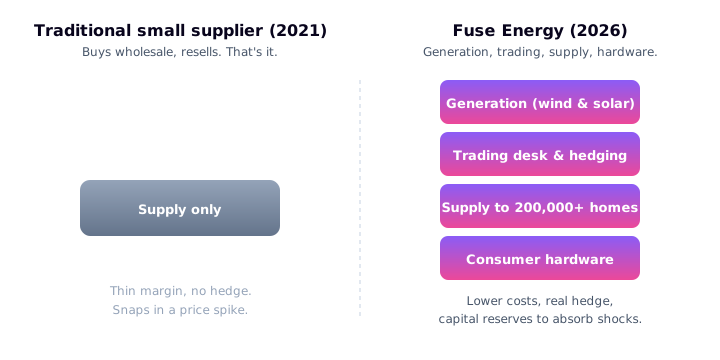
So when Fuse's founders argue the 2021 collapses weren't inevitable - they came from thin operations and weak hedging - the pitch is: build a well-funded, vertically integrated supplier and you can deliver lower prices with a better product.
September 2022
$78m seed round led by Balderton Capital and Lakestar
July 2023
Launch as first new supplier post-crisis, first to market after 28 collapsed
September 2024
$12m strategic round led by Multicoin Capital
July 2025
Unicorn status at £750m+ valuation, enters domestic gas market, hits $90m ARR
December 2025
$70m Series B at $5bn valuation, $400m ARR, 200,000+ customers, cash flow positive
That's the model. Fuse runs its own trading desk, hedges seriously, and holds capital reserves above the regulatory minimum. The 140+ team includes engineers from Meta, SpaceX, Tesla, Citadel, and Jump Trading. Fuse owns a wind farm and solar sites, runs its own trading platform, and is building consumer hardware.
Fuse Energy tariffs and prices: how competitive?
Fuse Energy prices are where the company stakes its claim. Thanks to Ofgem's ban on acquisition tariffs (SwitchInsights explainer), any cheap Fuse deal is open to existing customers too. Here is how Fuse Energy fixed tariff rates compare across UK regions:
| Region | Fuse Elec (p/kWh) |
OVO Elec (p/kWh) |
British Gas Elec (p/kWh) |
Fuse Gas (p/kWh) |
|---|---|---|---|---|
| Loading tariff data... | ||||
Indicative rates for comparison. Tariffs update regularly - always verify current pricing before switching.
📊 Annual Cost Comparison: Typical Household
Based on Ofgem typical consumption: 2,700 kWh electricity, 11,500 kWh gas. Cheapest fixed tariff per supplier, averaged across UK regions.
✅ The Verdict: Genuinely Competitive
For a typical dual-fuel household:
- Price cap cost: ~£1,641/year
- Next cheapest fixed: ~£.../year
- Fuse Fixed: ~£.../year
- Annual savings vs Q2 cap (£1,641): £...
- Projected savings vs Q3 forecast (£1,837): £...
The currently £100 dual-fuel exit fee means you need to stay ~12-15 months to see the full saving - standard for fixed tariffs.
Fuse Energy customer service and app review
✓ What Works Well
- Competitive pricing
- Strong app with real-time usage
- 24/7 chat with real humans, weekends included
- No estimated bills - pay actual usage
- Free smart meter, fast switching
- 4.7/5 Trustpilot (3,400+ reviews)
✗ Limitations
- No phone support (chat/email only)
- Direct debit only, variable monthly amount
- £100 exit fee (dual fuel, currently)
- ~2.5 years trading; sustained crisis untested
Biggest complaints: no emergency phone line and the variable monthly direct debit (Fuse says fixed DD is coming). See SwitchInsights' UK supplier complaints record for context.
The Warning Signs to Watch
⚠️ What to Keep an Eye On
The next big wholesale price shock. Fuse held pricing through the 2026 Iran/Hormuz spike, which was a partial test of the hedging book. A sustained 2021-style crisis is the deeper test still to come, and that's the one to watch for any newer supplier - Fuse included.
Should I switch to Fuse Energy?
Fuse delivers real savings and a strong digital experience. It held its pricing through the 2026 Middle East gas shock. The deeper test - a 2021-style crisis - hasn't happened yet.
📋 Consider Switching If:
- You're happy with app-based service
- You're on a default tariff at or above the price cap
- You want real-time visibility of usage and spending
- You're willing to switch again if warning signs emerge
🎯 Our Verdict
Fuse is the best-funded challenger supplier built so far - £.../year saved, 4.7/5 Trustpilot, $158m+ in VC runway.
On a default tariff and happy with an app-first supplier? Fuse is worth serious consideration. Pricing holds across regions and the model is genuinely different from the 2021 failures. Fuse passed the 2026 gas shock; a sustained 2021-style crisis is still to come.
Frequently Asked Questions About Fuse Energy
Is Fuse Energy any good?
Yes on most measures. The Fuse Energy cheapest tariff sits among the cheapest UK fixed deals, the app is the strongest in the market, and Fuse Energy Trustpilot reviews are 4.7/5 from 3,400+ entries. Trade-offs: no phone support, no prepayment meter.
Is Fuse Energy safe?
Yes. Fuse is fully Ofgem-licensed and holds capital reserves above regulatory minimums. If any supplier fails, the Supplier of Last Resort scheme ringfences your credit and transfers supply automatically.
Is Fuse Energy reliable?
So far, yes. Fuse held prices and service through the 2026 Middle East gas shock - its first real test. Complaint volumes run below the major-supplier average. A sustained 2021-style crisis has not happened on Fuse's watch yet.
Can Fuse Energy go bust?
Any supplier can, but Fuse is much better positioned than the 2021-22 failures: vertically integrated, $158m+ in capital, cash flow positive. If it ever did fail, Ofgem's Supplier of Last Resort scheme protects your balance and moves you without interruption.
Who owns Fuse Energy?
Founders Alan Chang (ex-Revolut CRO) and Charles Orr own the majority alongside employees, with Balderton, Lowercarbon, Accel, Lakestar, Ribbit, and Storonsky's QuantumLight holding the rest. Series B valued the company at $5bn.
Fuse Energy vs Octopus
Both tech-led. Octopus is much larger and offers phone customer support, prepayment meters, and EV-specific tariffs like Agile (a half-hourly tariff for electric vehicle owners). Fuse is usually cheaper on fixed dual-fuel and has a slicker app, but a narrower tariff range and no phone line. Pick Fuse for the cheapest fixed deal. Pick Octopus if you need phone support or drive an EV.
Fuse Energy vs British Gas
Mostly a price story. The Fuse Energy fixed tariff is typically £100-£150/year cheaper. British Gas wins on brand, engineer network, and phone support. Fuse trades that scaffolding for lower bills.
Fuse Energy smart meter support
Fuse installs SMETS2 smart meters free, and the app reads meter data half-hourly. SMETS1 meters work once they get their over-the-air upgrade.
Is Fuse the cheapest energy supplier UK-wide?
Consistently among the cheapest, not always the single cheapest energy supplier UK-wide - E.ON Next Pledge and some Octopus trackers occasionally beat it. If Fuse lands in your region's top three, locking in for 12 months is usually the safest way to save money.
Fuse Energy exit fee
Currently £50 per fuel (£100 dual fuel), and zero in the last 49 days of the contract. The savings usually cover the fee within 12-15 months. Always confirm the current fee on the Fuse Energy website before you sign up - tariff terms can change.
Get weekly energy insights
Plain-English breakdowns of what's actually happening with UK energy prices. No spam, no sales pitch - just useful stuff.
Unsubscribe anytime. We respect your inbox.
From the team behind SwitchInsights
Find a better energy deal in seconds
SwitchInsights is built by SwitchPilot. We score every deal on quality, not just price - so you switch to the deal that's right for you, not just the cheapest sticker.
Switch & Save →
Related reading:
Which Energy Supplier Has the Best Complaints Record? →
Energy supplier profits: where your £1,641 goes →
The Ban on Acquisition Tariffs →
Ofgem State of the Market 2026 →
Sources: Fuse Energy company announcements, Tracxn funding data, Sifted ($70m raise coverage, Dec 2025), EU-Startups, Startupmag.co.uk, Trustpilot reviews (3,400+), Uswitch supplier profiles, Energy-Review.co.uk, SwitchPilot tariff database. Valuation and ARR figures from verified investor reports and company statements.
Disclaimer: This review is independent. SwitchInsights has no commercial link to Fuse Energy. Tariff rates were accurate in February 2026 but change often. Verify current pricing directly before switching.